
A grill with open grates and a flat-top griddle can live on the same patio and still be different tools. The grill is built for flame, drippings, and grill marks. The griddle is a large, solid plate for smash burgers, eggs, fried rice, vegetables that would fall through a grate, and breakfast for a crowd. Plenty of households eventually want both; plenty of others would be happier if they bought the one that matches the food they actually cook.
This comparison explains those jobs, the fuel and space trade-offs, and what “hybrid” grill-plus-griddle inserts really give you. It is not a lab test, and it does not invent surface-temperature rankings. For fuel-type context, see gas vs charcoal vs pellet. For overall shopping, see how to choose a grill and Best Grills of 2026.
What an open-grate grill is for
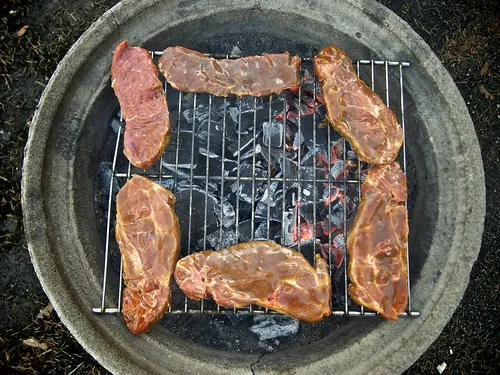
A grill puts food over (or next to) a fire, with air and drips moving through the bars. That is how you get char, rendered fat, and the two-zone setup used for thicker cuts and indirect cooks. If your weekends are steaks, bone-in chicken, corn, and the occasional smoked ribs, a grill is the native tool. See how to grill a steak and two-zone cooking.
You also have to live with flare-ups, food that can stick or slip, and a smaller “flat” real estate unless you add a plate or a basket. Vegetables, fish, and smash burgers are all possible on a grill, but they ask for more technique or accessories than they do on a griddle.
Gas, charcoal, and pellets all exist in grill form. A charcoal kettle is compact and flexible. A gas cart is quicker on a weeknight. A pellet grill is often closer to a set-and-hold smoker that can also roast; searing performance varies by official model, which is one reason to read pellet grill vs offset smoker if low-and-slow is the main job.
What a flat-top griddle is for
A dedicated outdoor griddle is a steel plate with burners under it, usually propane, sometimes in a small tabletop size and sometimes as a large cart. The plate gives you even, contact heat and a front grease channel. It is the right tool when you cook:
- Burgers you want to smash and smash again on a solid surface.
- Breakfast — eggs, pancakes, bacon — for more than one or two people.
- Chopped or sliced vegetables, quesadillas, fried rice, or smash-style sandwiches that would be a mess on bars.
- A lot of food at once, because a large plate is a single, usable rectangle rather than a set of grate gaps.
You do not get grill marks or the same dripping-fat smoke. You do get grease management as a weekly job: a well, a trap, and a plate that should be cleaned and lightly oiled according to the official care sheet, more like seasoning a grill than like ignoring a stainless grate. A dry, rusty plate is a miserable breakfast. A plate left caked in old oil is a smoke problem.
Griddles still belong outdoors, on a stable surface, with the same clearance and propane habits as a gas grill. See grill safety and how to check a propane tank, regulator, and hoses.
Inserts, side griddles, and “can’t I just have both?”
Many gas grills offer a small side burner, a porcelain or steel griddle insert that replaces a section of grate, or a full-width plate. Those are useful for onions next to steaks, or for a few eggs. They are not the same as a dedicated 30-plus-inch flat top. If 80% of your cooking is griddle food, buy a griddle. If 80% is steaks and chicken pieces, buy a grill and, if you want, a modest insert.
Some patio setups eventually include both, especially if you already have the tank storage and the space. In a small space, pick the tool you will use three nights a week, not the one that wins an imaginary cook-off.
Cast-iron pans and plancha-style plates on an existing grill can be a cheap trial. Heat them gradually, use them on a stable grate, and do not block all the airflow a charcoal fire needs.
Heat, fuel, and cleanup in plain terms
A grill’s lid is part of the cooker: you can roast, run two zones, and hold a lower temperature with the lid down. Many griddle cooks work lid-off, like a stove. Some griddle carts have a hood for wind and for a bit of roasting; official designs vary, and a hooded griddle is still not a smoker.
Preheat matters on both. A griddle that is only hot in the center will cook in rings. A grill with one working burner and a greasy leftover tray will flare. Cleanup on a griddle is scraping the plate while it is still warm, then a thin coat of oil if the official instructions say so. Cleanup on a grill is grates, burners, and a drip tray. Neither is zero-maintenance.
A short way to decide
- List the last ten things you cooked outdoors, or wanted to. If most of them wanted a plate, lean griddle; if most wanted bars and a lid, lean grill.
- Be honest about weeknights versus weekends, and about gas, charcoal, or pellets.
- Measure the patio, including clearance and tank storage, before you fall for a wide cart.
- Treat a small insert as a test, not as a full flat-top.
- Budget for a cover, a scraper or brush that matches the surface, and a thermometer.
You can cook a burger on either tool. The better purchase is the one that matches the shape of the food you already want to eat, in the space you have. Best Grills of 2026 is a researched shortlist of currently sold grills; if you are mainly shopping a flat top, compare official plate size, grease management, and warranty the same way you would compare a firebox.