
Most grill accidents are boring: a forgotten grease tray, a tank connection that was not tightened, a grill pulled too close to a siding wall, or a cover left on a grill that was not fully out. None of that is dramatic until it is. This guide is a practical safety checklist for gas and charcoal grills, not a substitute for the manual that came with your grill or for local fire codes.
We are not a safety laboratory and we do not invent incident statistics. When in doubt, follow the manufacturer’s instructions and your local fire department’s published advice. If you are still choosing a grill, placement and cleanup should sit next to fuel type in how to choose a grill.
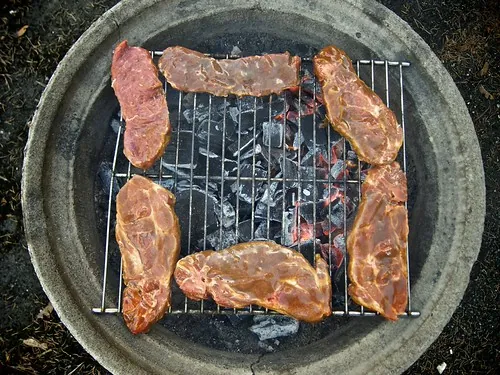
Place the grill as if it will flare
A grill belongs outdoors, in a space that can vent. Garages, covered walkways with no air movement, and indoor spaces are the wrong places, even in bad weather. Keep the grill away from siding, railings, low branches, cushions, and anything else that can catch. Manufacturers publish minimum clearances for a reason; if your deck is tight, a smaller kettle may be safer than forcing a wide cart against a wall.
Set the grill on a stable, non-combustible surface. A wobbly cart on a sloped board is how full grease pans tip. If you grill on a wooden deck, know that grease and embers can still reach the boards, and check whether your building or HOA has extra rules. Do not move a lit grill, and do not leave a lit grill unattended, including a charcoal fire you assumed was already out.
Propane: check the path from tank to burner
Before the first use of the season, and after any tank swap, inspect the hose for cracking, abrasion, or the smell of gas. Connect the tank with the grill burners off and the lid open. Then do a leak check: brush soapy water on the tank valve, regulator, and hose fittings, and watch for bubbles after you open the tank valve. Bubbles mean a leak. Close the valve, do not light the grill, and fix the connection or replace the damaged part before you try again.
If you smell gas while the grill is running, turn the burners off, close the tank valve, and move away from the grill. Do not keep clicking the igniter. If the smell does not clear or you cannot shut the tank down safely, leave the area and call emergency services.
Light a gas grill with the lid open so unburned gas does not collect under the lid. If a burner does not light, shut the gas off, wait, and then try again. A delayed ignition — a whoosh or a pop when gas finally lights — is a warning that gas had time to build up.
Store spare tanks upright, outdoors, and away from heat. Do not keep a spare tank in a car cabin or a hot garage “just for the weekend.” Close the tank valve when you are done cooking, not only the burner knobs, so a leaky valve or hose is not sitting pressurized overnight.
Grease fires: starve them, do not spray them
Grease fires start when drippings hit a hot firebox, a burner, or a full collection pan. You reduce the odds with regular cleaning: scrape the grates, empty the drip tray, and do not let a year of fat bake into the bottom of the cart. A cover and a basic cleaning kit are less glamorous than a new sear burner and more useful on an ordinary Tuesday.
If a grease fire starts, do not throw water on it. Water can spread burning grease. Turn the burners off if you can do so safely, close the lid to starve the fire of air, and close the tank valve on a gas grill. On a charcoal grill, closing the lid and the vents is the same idea. If the fire is already out of the grill, or you cannot get to the controls safely, move back and call the fire department. A small, contained flare from a fatty steak is not the same as a pan that is already burning; use judgment, and do not lean over the fire to “save” dinner.
A box of baking soda is sometimes mentioned for very small, contained grease flames on a pan. It is not a plan for a grill that is already fully involved, and it is not a reason to skip a lid and a shutoff.
Charcoal and embers have a longer life than dinner
Charcoal stays hot long after the food is off. Let coals burn down, close the vents to extinguish them, and give the ashes a long time to cool before you dump them. Use a metal can for cold ashes, not a paper bag or a plastic bin. Do not dump ashes in the woods, a mulch bed, or a trash can that still holds anything combustible.
Starter fluid, if you use it at all, belongs only on unlit charcoal, never on a fire that is already going. A chimney starter and long matches or a wand lighter keep your hands away from the grate. Keep children and pets a full step farther from a charcoal grill than you think is necessary; the bowl stays hot on the outside.
After the cook
Turn the gas off at the tank. Close charcoal vents. Make sure the grill is fully out before you put a cover on it. A cover on a still-hot grill can melt, and a cover on a grill that is still smoldering can trap heat against a wall or a rail. Empty the grease tray when it is cool enough to handle. If you had a serious flare or a leak, do not just cook again the next night; find the cause.
Safe grilling is mostly habits: lid open to light gas, soapy-water leak checks, a clear radius around the cart, and a grease tray that is not a science project. Those habits travel with you from a compact patio kettle to a full-size cart in our 2026 grill list.